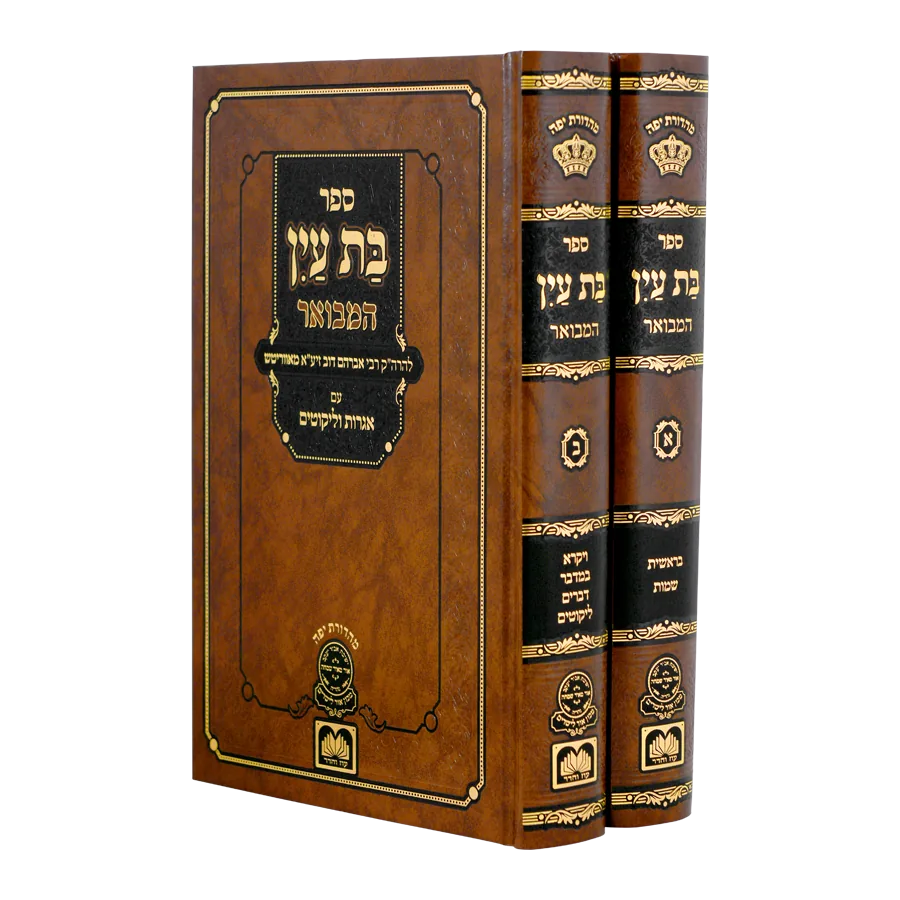
With God's help • 12 Kislev • The Bat Ayin's Hillula
From the sacred book Bat Ayin

Selected Insights
From His Torah Teachings

Selected teachings on serving God, faith, humility, Shabbat and repentance, arranged for reading and study.

An annotated edition of Bat Ayin
Light for Life

22 Insights from the Tzaddik's Teachings

Select a heading to open the full teaching. Numbered references are collected at the bottom of the page.

01A Chanukah teaching from Parashat VayeshevFinding Merit in the Jewish People through Chanukah+

“About three months later, Judah was told: Tamar has acted immorally...”1The writings of the Ari, of blessed memory, teach2 that the final sealing of the judgment takes place on Chanukah. We may therefore understand these verses as an allusion to the following: “About three months later” means the period from Rosh Hashanah until Chanukah, when the judgment is finally sealed. The accuser then comes before the blessed Creator of all worlds, alluded to here by the name Judah, to accuse human beings3and say: “Your daughter-in-law Tamar has acted immorally.” This refers to the community of Israel, compared to a date palm, tamar,4and called a bride:5 she has strayed from You and followed wayward desires. Not only has she followed the desires of her heart, “she is also pregnant through immorality.” Pregnancy here represents attachment: she is supposedly attached to those desires of her own accord, without any external cause.

“Judah said,” meaning the blessed Creator: “Bring her out and let her be burned,” because, according to the accusation, no external cause or obstacle led her astray; she became attached to her heart's desires entirely of her own accord. “As she was being brought out, she sent to her father-in-law, saying...” She offers a truthful defense: the accuser has falsely claimed that human beings are deeply attached to harmful desires. In truth,“By the man to whom these belong I am pregnant.” This means that we, His people, are attached only to the blessed Creator of all worlds, the source of kindness. The numerical value of the Hebrew words eleh lo, “these belong to him,” alludes to this. When we sometimes act against His will, it is because of the pressures of daily life, earning a livelihood and other human circumstances. Deep within our hearts, however, we remain lovingly and intensely attached to the Creator alone.

She then offers the blessed Creator further genuine evidence: “Please recognize whose seal this is,” alluding to the oil of the Chanukah lights, which bore the High Priest's seal;6, “the cords” allude to the wicks of the Chanukah lights; “and the staff” alludes to the vessel holding the Chanukah light. The numerical value of the Hebrew word hamatteh, with one added for the word itself, equals keli, “vessel.” The mitzvah of lighting Chanukah candles according to Your holy will clearly demonstrates that we seek Your will and are attached to You alone. Our occasional departures from that will arise only from the pressures described above.

“Judah said,” meaning the blessed Creator: “She is more righteous than I.” As it were, “I bear responsibility for this.”7The blessed Creator acknowledges that their defense is right: I see that they are truly attached only to Me, and that their occasional actions against My will arise only because “indeed, I did not give her to my son Shelah.” Shelah alludes to our righteous Messiah, as the verse says:8 “Until Shiloh comes.” For so long I have not entrusted them to that faithful shepherd, our righteous Messiah. May he come speedily in our days. Amen; may this be God's will.

Back to the list ↑
02A Chanukah teachingAnswering the Beit Yosef's Question+

People ask:9Why is Chanukah celebrated for eight days, when the miracle lasted only seven?

One possible answer follows from the Sages' teaching10 that the blessing hamotzi should be pronounced with its initial heh, since a person's blessings reveal whether he is a Torah scholar. Similarly, Beit Hillel rules that the Chanukah lights increase each day. If Chanukah lasted only seven days, four lights would be lit on the fourth day under both Beit Hillel's increasing order and Beit Shammai's decreasing order. It would then be impossible to distinguish the two practices that day. With eight days, the practice follows Beit Hillel visibly on every day, including the fourth.

This is hinted at by Abudarham, cited in Ateret Zekenim:11Chanukah is read as an acronym for “eight lights, and the law follows Beit Hillel.” The eight-day structure makes that ruling apparent. This idea dates from my childhood, and I do not remember whether I proposed it myself or heard it from someone else.

Back to the list ↑
03Parashat BamidbarThe Heart's Preoccupation with Livelihood+

“A net is spread over all living beings”: the search for food and a livelihood can become the net that traps a person. He seeks his bread through schemes and calculation, assuming that his own strength will provide it, rather than trusting that God will supply his needs. The One who gives life also gives sustenance. The Baal Shem Tov explained the word perusah, “spread,” through the Talmudic word peras, a portion of bread. The net of livelihood reaches everyone. When the mind and heart are constantly occupied with earning a living, the heart has no room left for serving God.

But when a person continually considers God's kindness—how He opens His hand and satisfies every living being—and trusts wholeheartedly that His great kindness will provide a livelihood without excessive scheming, the heart and mind can turn to Torah and mitzvot. Through Torah study, God then shines His holy light upon that person, for “Torah is light.” He rises from one spiritual level to another until he becomes like a sanctuary in which the Divine Presence dwells.

Back to the list ↑
04Parashat BalakDeveloping a Generous Eye+

This is the “generous eye” possessed by our forefather Abraham, as the Sages describe:12 “A generous eye, a humble spirit and a modest soul.” How does one attain a generous eye? Through a modest soul and a humble spirit. First, a person should become accustomed to limiting worldly indulgence, being content with what is necessary to sustain life and serve God, rather than pursuing luxuries. A humble spirit will follow naturally. The verse warns: “You will eat and be satisfied, and your heart will become proud.”13 Excessive food, drink and worldly pleasures can lead to arrogance. Balaam pursued honor and indulgence with an insatiable soul, acquiring a proud spirit and an ungenerous eye. Abraham, by contrast, had a modest soul and did not pursue honor or worldly pleasure. He thereby refined the soul, attained humility of spirit and cultivated a generous eye, corresponding to the higher soul.

Back to the list ↑
05Parashat BalakWhat Brings Blessing to the Jewish People?+

Through the dwelling of the Divine Presence, in the aspect of God's kingship, goodness, blessing, abundance and life flow to Israel. As the Maggid explained14 the Sages' statement:15 “Israel is not subject to the stars.” He read ayin, “nothingness,” as humility: humility is Israel's source of blessing. When Israel attains this humility, blessing, goodness and life flow to them. By humbly accepting the kingdom of Heaven and attaching themselves to holiness, they receive goodness, and their accusers are silenced and removed.

Back to the list ↑
06Parashat PinchasThe Heart of Faith: God Does Everything+

A fundamental principle in serving God is complete faith that the blessed Creator is one, unique and perfectly united, unlike anything else. He alone is our God, past, present and future; He creates and guides every being and watches over every detail. He alone has made, makes and will make all things. With this faith, a person's whole desire should be to fulfill the Creator's will, without seeking more than that will provides. If God wishes to give something, He will certainly give it without hindrance. If He does not, why exhaust oneself in an empty pursuit that brings no benefit?

Back to the list ↑
07Parashat PinchasEven Judgment Is Mercy+

The essence of serving God is knowing that the Lord is God, as the verse says:16 “Know this day and take it to heart that the Lord is God.” Even when harsh judgment prevails, a person should understand that it is kindness from the Creator, intended to lead him back in repentance. His heart should become broken and contrite. Through this reflection, judgment is transformed into mercy, because he recognizes that the judgment itself expresses divine mercy and kindness. In this way harsh judgments are sweetened into kindness and mercy; this is how the righteous transform judgment into mercy.

Back to the list ↑
08Parashat MaseiLove and Awe Directed to God Alone+

One should fear nothing except God's honored and awesome name alone, as we pray each day:17 “Reign over us, You alone, Lord, with kindness and mercy.” We ask for His gracious help even though we are unworthy: help us accept Your kingship alone, Creator of all worlds, to revere You and love You completely. Nothing, great or small, can occur without His providence and will; thus our ultimate awe and love should be directed to Him alone.

Back to the list ↑
09Parashat VaetchananTwo Ways the Evil Inclination Tries to Bring a Person Down+

A person must take great care not to fall into either of the evil inclination's two traps. The verse warns and hints at this:18 “Only take care, and guard your soul very carefully.” The word rak, “only,” suggests limitation, as the Sages say:19 The words ach and rak qualify or limit a statement. Guard yourself when you feel diminished: when you see the damage you have caused in the higher worlds and your heart sinks, do not despair. Instead, be strong and courageous, and trust that God desires kindness and accepts those who return. “Guard your soul very carefully” also recalls the Sages' teaching:20 “Be exceedingly, exceedingly humble.” The word me'od, “exceedingly,” also alludes here to inflated pride, associated with “great Rome”; one must guard against it.

Back to the list ↑
10Parashat EkevReceiving the Gift of Shabbat+

On Shabbat, a person must guard actions, speech and thoughts. Scripture explicitly warns about the first two. Regarding action, it says:21 “You shall not do work”; regarding speech, it says:22 “Nor speaking of matters,” which the Sages interpret23 to mean that Shabbat speech should differ from weekday speech. These two are within a person's control: one can restrain the hands from work and the mouth from weekday talk. They are “the revealed things that belong to us and our children.”24Thoughts in the heart and mind, however, are hidden and are not wholly under human control; they belong to the Lord our God. He bestows their sanctification as a gift upon those who merit it. This is what the Sages suggest when they say:25 God told Moses, “I have a precious gift in My treasury, and Shabbat is its name.” The phrase “in My treasury” deliberately echoes “the hidden things belong to the Lord our God.” It refers to thought: the mind too should share in Shabbat's holiness. This hidden dimension is in His treasury, and He grants it as a precious gift to those who merit it.

A person should therefore first sanctify actions and speech with the holiness of Shabbat, and ask God for help and for the precious gift of sanctifying the thoughts of the heart and mind as well.

Back to the list ↑
11Parashat Re'ehWealth as a Means of Serving God+

Why is receiving reward in this world for the commandment “I am the Lord” considered an advantage? Would it not be better to receive it in the enduring World to Come rather than in this passing world? The point is that serving the blessed Creator requires a settled mind. Some material reward is needed here so that a person can serve Him with peace of mind.

The Sages hint at this in “Tithe so that you may become wealthy.” It seems surprising to tithe for a reward. Yet one may wish for wealth in order to gain the space and peace of heart needed to serve God. The Midrash also reads it as “Tithe so that you will not lack”: so that lack of livelihood will not hinder divine service. Another reading is “so that you may become diminished,” meaning that the heart becomes free to recognize its own shortcomings and lowliness.

Back to the list ↑
12Parashat Re'ehEven God's Rebuke Can Become a Blessing+

We may also understand “the blessing, if you listen... and the curse, if you do not listen...” as follows: even the Creator's curse can be a form of blessing, because it prompts a person to return in repentance. That return is itself a blessing. May God grant us genuine repentance. Amen; may this be His will.

Back to the list ↑
13Parashat ShoftimEvery Good Thing Is a Gift of Kindness+

The Torah's command to give the first portion of everything to the priest conveys a moral lesson. A person should recognize that all the good bestowed by the blessed Creator comes from freely given kindness, rather than personal achievement or “my strength and the power of my hand.”26 One's deeds alone would not merit all this, or even less. Such recognition comes through genuine humility: knowing one's own limitations and lowliness. Then everything God does for a person is understood as an undeserved gift of kindness.

Back to the list ↑
14Parashat NoachDedicating Everything to Heaven+

The essence of serving God is “In all your ways, know Him,”27 in both spiritual and physical matters. Bring everything under the authority of the One God and serve Him through both. Spiritual service is the aspect of kindness: loving God deeply through Torah, prayer, mitzvot and acts of kindness, with one's body and money, for His sake. Physical life, associated with restraint, includes eating, drinking and other necessities; these too should be undertaken with the intention of serving Him.

This is da'at, the joining of kindness and restraint: uniting physical life with spiritual life. A person subdues worldly cravings so that love of the Creator burns continually in the heart. The yearning becomes like a divine flame, binding mind and heart to God so fully that other pleasures lose their hold. Food is then eaten out of necessity, to relieve hunger and gain strength for divine service, and to elevate the holy sparks within it. Every act should offer a place for God; if it does not, one should refrain. One looks only for the divine service within each thing, for His unity is incomparable and He is present everywhere.

This is “In all your ways, know Him”: even while attending to physical needs, unite them with spiritual purpose. Seek not personal pleasure for its own sake, but the sustenance needed to serve God, as the verse says:28 “Let your garments be white at all times”—even while engaged in bodily needs. This is the essence of da'at: joining life to kindness.

Back to the list ↑
15Parashat NoachRepentance Brings Redemption Closer+

Repentance begins when a person reflects on God's greatness and believes fully that He examines the innermost heart and knows every human deed and scheme, as the verse says:29 “Can anyone hide in secret places without My seeing him?” A person then examines past deeds and thoughts that opposed God's will, becomes deeply ashamed and humble, and sincerely regrets them. He resolves to follow God's ways and fulfill His will. What is that will? “To work it and guard it”:30to work it through positive commandments and guard it through prohibitions,31with love and awe before God, and with fixed times for Torah study. This awakening below brings an awakening above. Regret for past deeds stirs, as it were, divine compassion and reconsideration of exile, the suffering inflicted by the nations and the suffering of individuals and Israel as a whole. Good deeds and faith in the God who desires kindness draw abundant kindness from above. Fixed Torah study brings the light of the Torah's twenty-two spiritual letters and the breath of life.

Back to the list ↑
16Parashat ToldotWhat Makes Prayer Accepted?+

“Isaac entreated the Lord on behalf of his wife, because she was barren, and the Lord answered him.” Rashi explains: him, rather than her, because the prayer of a righteous child of a righteous parent differs from that of a righteous child of a wicked parent.

We may explain this through a teaching I heard from the holy Rabbi Ze'ev of Zhytomyr on “Who chooses songs of praise”:32the Creator chooses the “remainders” of song—a play on shirei, “songs,” and shirayim, “remainders”—meaning those who make themselves humble and insignificant while singing and praying. These are gracious words from a wise teacher.33The essence of divine service is true humility. When standing in prayer before the Creator of all worlds, a person reflects: my deeds do not make me worthy to speak before Him or ask for anything, great or small. I am not even worthy to open my mouth in petition. I therefore ask God to help me through the merit of my ancestors.

Such prayer is accepted before Him, as it says: “The Lord is near to all who call upon Him, to all who call upon Him in truth.” He draws near to receive prayer offered in truth, through ancestral merit. Emet, “truth,” is associated here with the ancestors and with beginning, middle and end.

A righteous child of a righteous parent can appeal to ancestral merit. A righteous child of a wicked parent cannot do so in the same way and must appeal primarily to personal deeds. God does not turn to such a prayer in the same manner, for He chooses “songs of praise”—the prayer of one who makes himself like a humble remainder.

Back to the list ↑
17Parashat VayishlachCultivating Humility and a Sense of Accountability+

Arrogance is the source of harmful traits and forces of impurity; holiness withdraws from one who is proud. A person must therefore be exceedingly careful to remain humble, continually considering the negative traits and bodily desires that have not yet been corrected. This brings humility and a sense of shame before the blessed Creator, leaving no room for pride.

Back to the list ↑
18Parashat VayigashReflecting Continually on One's Divine Service+

Even a person who serves God constantly should reflect each day on how far he remains from Him. All his service is as nothing compared with what is required. He should see himself as someone who has not yet tasted God's sweetness, like a child born today, and begin anew. He should yearn to experience God's goodness and pray for help to begin and finish well. His heart should be humbled by the days and years since his birth in which he has not yet truly tasted that sweetness.

Back to the list ↑
19Parashat ShemotGuidance for the Struggle with the Evil Inclination+

A person's central task is the daily struggle against the evil inclination, called Pharaoh—whose Hebrew letters can also form oref, “the back of the neck”—34which draws him toward material desires and the vanities of this world. This is the spiritual meaning of exile in Egypt, and it is a great struggle.

Three things are needed for this struggle. First is Torah: set aside regular times and study continually. Second is humility: recognize one's lowliness and immersion in worldly desires that are not life's true purpose. A humble, broken heart weakens the evil inclination. Third is prayer to the Master of mercy for compassion and strength to resist this “Pharaoh.” God will subdue it and help the person emerge from exile. These practices must be pursued every day, without losing sight of them.

Back to the list ↑
20Parashat ShemotThe Heart of Divine Service: Wanting to Become Better+

Divine service should be rooted in the aspect of Ehyeh, “I will be,” as the verse says:35 “Tell the children of Israel: Ehyeh has sent me to you.” A person immersed in worldly desires may pray for God's sake, yet still treat material concerns as central. In blessings such as “Heal us” or “Bless this year for us,” he understands prayer's higher purpose of bringing spiritual unity, but also seeks its literal, material benefit. How can imperfect intention achieve full unity above? In His abundant mercy and kindness, God joins Israel's good intention to action.36When a person recognizes the imperfection of his service and intention, his heart breaks and he longs for God's help so that spiritual concerns become primary and material concerns secondary. This is the aspect of Ehyeh: a future in which greater completeness will come with God's help.

Even when sins and insufficient service have left a person distant from God, he trusts in God's great kindness to forgive him and grant him the ability to begin serving anew. Through this he can attach himself to the holy name Ehyeh, which expresses: from now on, with God's help, I will become a servant of God.

Through Ehyeh—humility and the longing to cleave to God and be close to Him, associated with the realm of Atzilut—a person merits deliverance.

Back to the list ↑
21Parashat Va'eraThe Light of Repentance Rescues Even after Sin+

When a person sins, becomes brokenhearted and returns in complete repentance, he draws the light of repentance upon himself. This is very precious in God's eyes, for God desires a dwelling in the lower world.

It is certainly harder to cleave to God after sin, when the heart has become coarse and stained. God therefore promises: “I am the Lord before a person sins; I am the Lord after a person sins”:37even after sin, a broken heart and humble spirit draw down the light of repentance, which is greater than the person's original spiritual state before sinning.

Back to the list ↑
22Parashat Va'eraHumility Gives Life and Strength to Our Words+

The essential preparation for prayer is humility. Having first humbled himself, a person can pray with holiness, purity and fervor, giving real spiritual life to the letters he speaks, like the life within the letters through which the world was created. All worlds were created through the twenty-two letters.38When words are spoken with holiness and purity, they draw abundance and blessing. As the Zohar teaches:39 “Those blessings... and those words of a person”: human words draw blessings above and below. Prayer offered with humility is accepted. This is “The Lord God formed the human being from the dust of the earth”:40when a person is truly humble and sees himself as dust, “the human being became a living soul,” translated by Onkelos as “a speaking spirit.” He can then speak words that bring blessing and abundant goodness.

Back to the list ↑
Sources and Notes +
  1. 1. Genesis 38:24–26
  2. 2. Chemdat Yamim, Chanukah; see Zohar III, 259a, and Me'ir Einei Chachamim, Gate 13, chapter 2
  3. 3. See Zohar I, 89b
  4. 4. Shemot Rabbah 36:1
  5. 5. Pesikta Rabbati, section 37
  6. 6. Shabbat 21b
  7. 7. See Rashi's commentary
  8. 8. Genesis 49:10
  9. 9. Beit Yosef, Orach Chaim 670
  10. 10. Berakhot 38a
  11. 11. Beginning of the laws of Chanukah
  12. 12. Pirkei Avot 5:19
  13. 13. Deuteronomy 8:12–14
  14. 14. Me'or Einayim, Psalms
  15. 15. Shabbat 156a
  16. 16. Deuteronomy 4:39
  17. 17. In the Amidah prayer
  18. 18. Deuteronomy 4:9
  19. 19. Jerusalem Talmud, Sotah 5:5
  20. 20. Pirkei Avot 4:4
  21. 21. Exodus 20:10
  22. 22. Isaiah 58:13
  23. 23. Shabbat 113b
  24. 24. Deuteronomy 29:28
  25. 25. Shabbat 10b
  26. 26. Deuteronomy 8:17
  27. 27. Proverbs 3:6
  28. 28. Ecclesiastes 9:8
  29. 29. Jeremiah 23:24
  30. 30. Genesis 2:15
  31. 31. Zohar I, 27a
  32. 32. The Yishtabach prayer
  33. 33. An abbreviation meaning “The words of a wise person's mouth are gracious”
  34. 34. Likkutei Torah, Vayeshev, teaching beginning “Vayehi achar hadevarim”
  35. 35. Exodus 3:14
  36. 36. Kiddushin 40a
  37. 37. Rosh Hashanah 17b
  38. 38. See Zohar I, 204a
  39. 39. See Zohar I, 64b and 229b
  40. 40. Genesis 2:7
Further Reading

Discover the tzaddik's life and legacy

Read his biography →

From Reading to Joining the Hillula

Join the hillula meal in honor of the Bat Ayin, or help support the meal.