Childhood and Rabbinic Leadership
Rabbi Avraham Dov of Avritch was born around 5520 (1760) in Khmelnyk, Ukraine.
His father, Rabbi David, was the rabbi of Khmelnyk, a renowned preacher and a distinguished tzaddik. He lost his father at age nine. He later married the daughter of Rabbi Natan Neta, rabbi of Avritch. After his father's passing, he was appointed rabbi of Khmelnyk. When his father-in-law died, he accepted the people of Avritch's request to become their rabbi. His brother, Rabbi Yosef Tzvi, succeeded him in Khmelnyk.
He also served as head of the rabbinical court in Zhytomyr. His original family name was Auerbach, but his association with Avritch was so strong that he became widely known as “the Rabbi of Avritch.” Over approximately forty years of leadership, he established measures to strengthen Torah and holiness and raised students devoted to God and His Torah.
His Teachers and Spiritual Stature
Rabbi Avraham Dov Ber of Avritch studied under Rabbi Menachem Nachum of Chernobyl, his son Rabbi Mordechai of Chernobyl and Rabbi Levi Yitzchak of Berditchev. He became known as a lofty tzaddik of exceptional humility and remarkable ascetic discipline.
His students and admirers called him Ha'Adam, an acronym formed from Avraham Dov of Avritch.
His Journey to the Holy Land
It is told that an emissary from the Land of Israel spoke before him with enthusiasm about its holiness: the Western Wall, the Cave of the Patriarchs, Rachel's Tomb and Rabbi Shimon bar Yochai's resting place. He concluded that even the ordinary stones in its streets were not merely stones, but “golden stones and precious gems shining like sapphires.”
From that day, love for the Land of Israel burned within him. In 5591 (1831), he moved to Safed, was received with great honor and became rabbi of the Hasidic community. His book Bat Ayin also contains many teachings praising the Land of Israel.
Where Were the Shining Stones?
Years later, he met the same emissary and asked where those shining stones were. “Those who are worthy merit seeing them,” the emissary replied. According to tradition, the tzaddik secluded himself for a full year of divine service, solitude and abstinence. At the year's end, he held a meal and explained that, having refined himself, he now saw the ordinary stones shining like sapphires.
The Ship Miracle and the Remarkably Short Journey
Settling in Safed
He initially considered Jerusalem or Haifa, drawn to Elijah's Cave. He ultimately chose Safed, the city of the holy Ari, Rabbi Yosef Karo, author of Beit Yosef, and other Jewish sages. He purchased a home and established a study hall that soon became a gathering place for scholars.
A House of Hospitality
In Safed, he established free lodging and meals for travelers, particularly pilgrims heading to Meron. When his own home could not accommodate everyone, he asked his neighbors to welcome the visitors.
Prayer and Sacred Melody
The rabbi frequently prayed at the graves of tzaddikim on behalf of the Jewish people. He was also gifted in sacred melody. The tunes he composed were sung in synagogues in Safed, Tiberias and Jerusalem, inspiring spiritual awakening and closeness to God.
On Rosh Hashanah, before the shofar blasts, he said just one sentence to the congregation: “My teachers and friends, today is Rosh Hashanah—we must repent.” These simple words, spoken from the heart, moved the entire congregation to tears and repentance.
The Peasants' Revolt
During the Peasants' Revolt, rebels entered Safed and looted Jewish property. The rabbi hid with members of his community in the qadi's courtyard. For weeks he survived with almost no food, sharing the little he had with others.
Following Rabbi Yisrael of Shklov's intervention, the Jews were released on 10 Tammuz. The Bat Ayin designated the day a “minor Purim” of thanksgiving. He later appealed to Moses Montefiore for help rebuilding the community.
Dr. Eliezer Levy, Montefiore's secretary, described him as a worthy man who served the community without payment and distributed his own possessions among its poor.
The Earthquake and the Study Hall Miracle
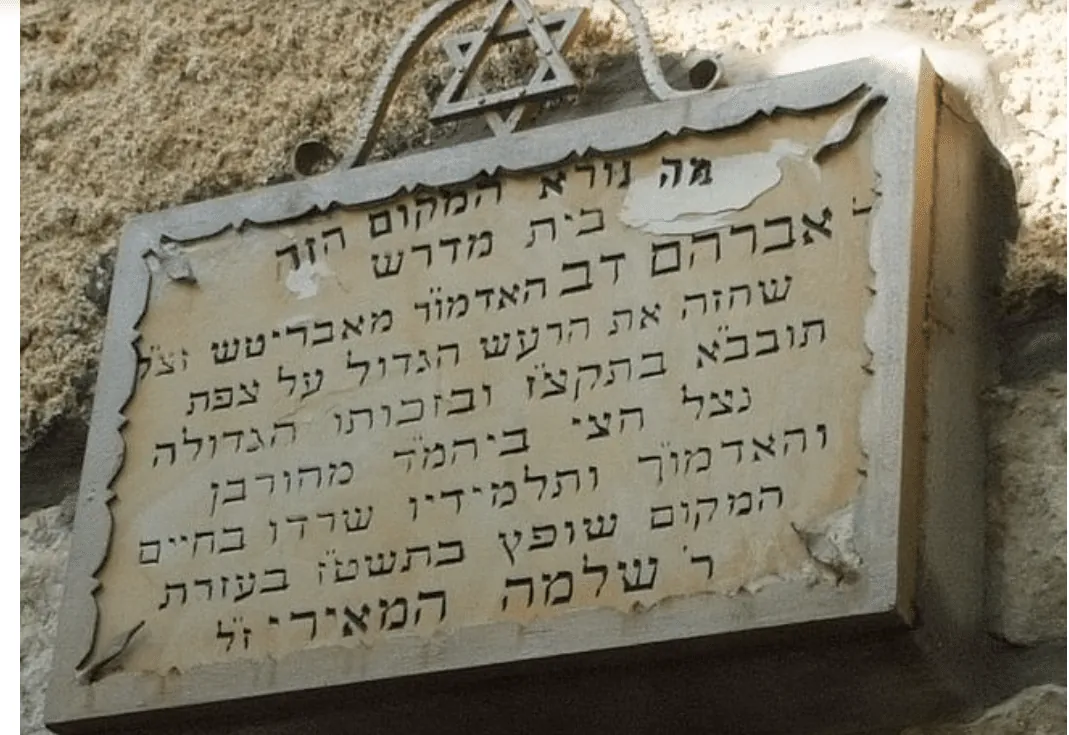
During Safed's devastating earthquake, the rabbi was praying Minchah in his study hall. As the tremors began, he called the worshippers to gather around him and lay prostrate on the ground. The study hall's walls collapsed, but the place occupied by the tzaddik and his students remained standing.
A memorial stone was placed in the study hall to commemorate the miracle. The rabbi explained that he had seen stones thrown in an unnatural manner and understood that the moment called for complete humility and self-nullification; that was why he lay on the ground.
Read the full rescue story and its sources
Rebuilding the City
After the disaster, he led the care of survivors and the rebuilding of the city. He set up a shelter on the hillside for the wounded, hungry and sick, and worked to raise resources. When some urged the residents to leave Safed, he assured them that such a calamity would not recur before the coming of the righteous redeemer. His words encouraged those who stayed, and the Jewish community was reestablished.
In 5600 (1840), he founded Safed's burial society, so that every deceased person would receive proper dignity.
The Epidemic and His Passing
In 5601 (1840), an epidemic broke out in Safed. The tzaddik too became ill and promised his community that he would be its last victim. He passed away on 12 Kislev, and the epidemic ceased.
He was buried in Safed's ancient cemetery near the author of Arvei Nachal. His burial chamber remains a place of prayer for Jewish visitors from near and far. His student Rabbi Shmuel Heller succeeded him as leader of the community. The Bat Ayin left no children.
His Students and His Book
His students included Rabbi Hillel of Paritch, Rabbi Tzvi of Mezhritchka, Rabbi Shlomo Chaim of Koidanov, Rabbi Shmuel Heller and Rabbi Uri Ornstein.
His book Bat Ayin was written in Safed and contains profound Hasidic teachings on serving God, setting aside the ego and cleaving to the Divine. His path combines simple reverence for Heaven with inner depth, joy, humility and love for the Jewish people. Two halachic responsa printed at the end of the book attest to his brilliance and breadth of Torah knowledge.
An Enduring Legacy
12 Kislev, the anniversary of his passing, is his hillula. A large commemorative meal is held in Safed with many participants. In 5764 (2004), a Torah school named Bat Ayin was established in Safed in his honor.